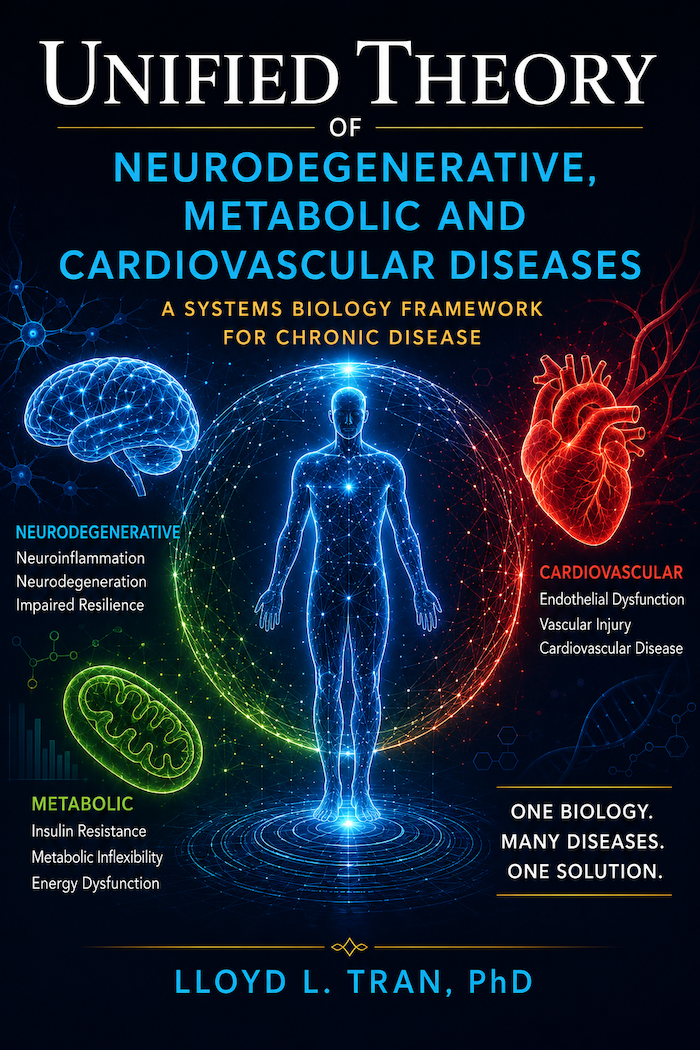
The Unified Theory of Neurodegenerative, Metabolic and Cardiovascular Diseases
Lloyd L. Tran, PhDIn Press
Book Highlights:22 chapters
450 pages
more than 1,500 scientific references
150 full-color figures and illustrations
Preface
This book represents the culmination of my twenty-five years of scientific research, drug discovery, and clinical development dedicated to understanding the fundamental mechanisms underlying neurodegenerative, metabolic, and cardiovascular diseases.
My journey into this field began in November 2001, when I filed a patent application for a novel compound that demonstrated neurogenesis in animal studies for the treatment of dementia and Alzheimer’s disease. At that time, the concept of neurogenesis in the adult mammalian brain remained controversial. During my postgraduate studies in the late 1970s, I was taught the long-standing doctrine that neurons in the adult brain could not regenerate. This belief was rooted in the teachings of Nobel Prize-winning neuroscientist Santiago Ramón y Cajal, who famously declared in his 1928 foundational work, Degeneration and Regeneration of the Nervous System, that in the adult brain, “nothing may be regenerated.”
Although pioneering researchers such as Joseph Altman and Gopal Das challenged this doctrine in the 1960s, adult neurogenesis was not widely accepted for decades. Because no approved therapies at the time demonstrated neurogenic activity, it took more than six years to convince the United States Patent Office of the novelty and utility of my invention before the patent was finally granted in 2007.
For more than thirty years, Alzheimer’s disease research has been dominated by the amyloid hypothesis, first proposed in 1992. This theory suggests that the accumulation of amyloid-beta (Aβ) plaques is the primary cause of neurodegeneration in Alzheimer’s disease. Over time, the hypothesis evolved into an accepted paradigm guiding much of Alzheimer’s research and drug development worldwide.
Yet despite decades of effort and billions of dollars invested, the outcomes have been disappointing. Numerous amyloid-targeting drugs failed in Phase II and Phase III clinical trials, and although three anti-amyloid monoclonal antibodies have recently received FDA approval based on reductions in amyloid plaque biomarkers, meaningful and sustained improvements in cognitive function have remained limited and controversial. These developments reinforced my belief that Alzheimer’s disease cannot be explained by amyloid accumulation alone.
As Chairman and Chief Scientific Officer, I have had the privilege of leading a talented team of scientists in advancing NA-831, a small-molecule therapeutic designed to promote neurogenesis and neuronal recovery. NA-831 successfully completed Phase I clinical trials and demonstrated proof of efficacy and safety in Phase II studies for Alzheimer’s disease. We subsequently developed related compounds, including NA-911 for stroke and NA-931 for obesity, which further revealed profound biological connections among neurodegenerative, metabolic, and cardiovascular disorders.
During the course of our research, we observed overlapping patterns involving insulin resistance, chronic inflammation, mitochondrial dysfunction, oxidative stress, vascular impairment, and disturbances in cellular energy metabolism. These pathological features appeared not only in Alzheimer’s disease, but also in obesity, diabetes, stroke, and cardiovascular disease.
Our findings were subsequently presented at major international scientific conferences, including the International Conference on Alzheimer’s and Parkinson’s Diseases (AD/PD) 2022 in Barcelona, Spain, the Alzheimer’s Association International Conference (AAIC) 2024 in Philadelphia, and the American Diabetes Association (ADA) 2025 in Chicago , where we reported clinical observations linking Alzheimer’s disease, obesity, and stroke through studies of NA-831, NA-931, and NA-911.
These observations led us to question the conventional view that these disorders should be studied and treated as isolated conditions. Increasing evidence suggests that the brain, vascular system, and metabolic system are deeply interconnected through complex biochemical and cellular signaling networks. Disturbances in one system may progressively influence dysfunction in the others through shared pathways involving inflammation, energy metabolism, vascular integrity, and cellular signaling.
Through these discoveries, several important questions emerged:
Why do insulin resistance and neurodegeneration so frequently coexist?
How does chronic inflammation connect vascular injury to cognitive decline?
Why do mitochondrial dysfunction, oxidative stress, and impaired cellular signaling repeatedly appear across seemingly unrelated chronic diseases?
Could Alzheimer’s disease, obesity, diabetes, stroke, and cardiovascular disease represent different manifestations of a common underlying biological failure?
This book is the result of years of scientific observation, experimental investigation, and clinical research conducted at Biomed, together with insights contributed by many researchers around the world. From these collective findings emerged a new realization: neurodegenerative, metabolic, and cardiovascular diseases may not be separate disorders, but interconnected manifestations of a common biological dysfunction.
This framework forms the basis of what I propose as the Unified Theory of Neurodegenerative, Metabolic, and Cardiovascular Diseases. By recognizing these diseases as interconnected processes rather than isolated conditions, this theory may open new pathways for prevention, diagnosis, and therapeutic development.
Scientific progress has always depended on the courage to question accepted assumptions. In that spirit, this work is offered not as a final answer, but as an invitation for continued exploration, discussion, and discovery.
Sir Isaac Newton once wrote:
“I seem to have been only like a boy playing on the seashore and diverting myself in now and then finding a smoother pebble or a prettier shell than ordinary, whilst the great ocean of truth lay all undiscovered before me.”
I remain deeply grateful to the many scientists, physicians, colleagues, patients, and researchers whose contributions and dedication have made this work possible. The future of medicine may depend not on treating diseases in isolation, but on understanding the biological networks that unite them. If this book contributes in some small way toward a more unified understanding of chronic disease and ultimately toward better therapies for patients, then its purpose will have been fulfilled.
Lloyd L. Tran
Introduction
In a world where Alzheimer’s, diabetes, obesity, stroke, and heart disease are treated as separate health crises, this groundbreaking book asks a bold question: What if they all stem from the same hidden biological breakdown?
Rather than viewing these conditions as isolated diseases, the book reveals how they may be deeply connected—different symptoms of a single system in collapse. By uncovering the shared roots behind today’s most devastating chronic illnesses, it challenges everything we think we know about health, aging, and disease.
For the first time in medicine, a bold new framework is introduced: The Unified Theory of Neurodegenerative, Metabolic, and Cardiovascular Diseases.This eye-opening journey connects the dots between the body, brain, metabolism, and modern lifestyle, offering a powerful new perspective on why so many people are getting sick—and what we can do to change course before it’s too late.
Blending scientific rigor with visionary insight, this book takes readers beyond symptoms and diagnoses into the deeper biological patterns driving modern disease. Each chapter peels back another layer of the puzzle, revealing how seemingly unrelated conditions may arise from shared mechanisms hidden in plain sight.
This is more than a scientific exploration—it is a paradigm shift. Written for physicians, researchers, innovators, and intellectually curious readers alike, the book presents a new theory, offering a sweeping vision of medicine’s future: one where prevention, diagnosis, and treatment are unified around the interconnected biology of human disease.
Once you see the connections, you cannot unsee them.
For generations, medicine has treated neurodegenerative disorders, metabolic diseases, and cardiovascular conditions as separate categories of illness. Alzheimer’s disease belonged to neurology. Diabetes belonged to endocrinology. Heart disease belonged to cardiology. Each field developed its own theories, treatments, specialists, and research pathways.
Yet despite enormous scientific progress, chronic diseases continue to accelerate globally. Patients frequently suffer from multiple conditions simultaneously: diabetes alongside dementia, obesity with hypertension, cardiovascular disease with cognitive decline. These overlapping patterns raise an urgent question:
These diseases are not truly separate at all!
Unified Theory of Neurodegenerative, Metabolic and Cardiovascular Diseases explores this profound possibility. The book presents an integrative scientific model suggesting that many chronic disorders share common biological roots—particularly dysfunctions involving metabolism, mitochondrial failure, inflammation, vascular impairment, oxidative stress, insulin resistance, immune dysregulation, and cellular energy collapse.
Rather than viewing disease through isolated medical silos, this work proposes a systems-level understanding of human health.
Why This Book Was Written
The modern healthcare system excels at specialization, but specialization can also fragment understanding. Researchers often focus on single organs, single pathways, or single diseases while missing the larger biological network connecting them.
This book was written to address several urgent realities:
• Chronic diseases are increasing worldwide despite advanced medicine.• Existing treatments often manage symptoms rather than root causes.
• Many diseases share strikingly similar pathological mechanisms.
• Patients with one chronic illness are highly susceptible to developing others.
• Scientific discoveries across disciplines remain disconnected.
The goal of this book is to unify emerging evidence from multiple medical fields into a coherent framework that explains how seemingly different diseases may arise from interconnected biological dysfunctions.
What Is the Central Problem?
The central problem explored in this book is that modern medicine often treats chronic diseases in isolation rather than recognizing their systemic interdependence.
The consequences are profound:
• Treatments become reactive instead of preventive.
• Root causes remain unaddressed.
• Research efforts become fragmented.
• Patients receive compartmentalized care.
• Healthcare costs continue to rise while outcomes stagnate.
At the biological level, the book argues that chronic diseases may stem from a convergence of underlying disturbances, including:
• Chronic inflammation• Mitochondrial dysfunction
• Insulin resistance
• Vascular degeneration
• Neurogenesis Impairment
• Oxidative stress
• Impaired cellular signaling
• Neuroimmune disruption
• Metabolic imbalance
These mechanisms affect the brain, heart, blood vessels, endocrine system, and immune system simultaneously—creating a cascading network of disease.
What Is the Proposed Solution?
The solution presented in this book is not a single drug or isolated therapy. Instead, it is a new way of understanding disease itself. The book advocates for:
1. Systems-Based Medicine
A holistic model that recognizes the interconnectedness of biological systems rather than separating organs into isolated specialties.
2. Root-Cause Prevention
Focusing on metabolic health, inflammation control, vascular integrity, and mitochondrial resilience before irreversible disease develops. .
3. Integrated Research
Encouraging collaboration between neurologists, cardiologists, endocrinologists, immunologists, and systems biologists. .
4. Personalized Therapeutics
Using biomarkers, genetics, metabolic profiling, and lifestyle interventions tailored to individual biological patterns.
5. Early Intervention
Detecting shared pathological mechanisms long before clinical symptoms emerge.
Ultimately, the book proposes that by understanding the common biological architecture behind chronic diseases, medicine can shift from symptom management toward true prevention and restoration of health.
Who Is This Book For?
This book is designed for both scientific professionals and intellectually curious readers seeking a deeper understanding of the biological connections underlying chronic disease. Unified Theory of Neurodegenerative, Metabolic, and Cardiovascular Diseases presents a comprehensive systems-biology framework that bridges neuroscience, metabolism, cardiology, immunology, aging science, and preventive medicine into a unified model of human health and disease.
Written in a scientifically rigorous yet accessible style, this work is intended for a broad interdisciplinary audience, including physicians, neurologists, cardiologists, endocrinologists, psychiatrists, biomedical researchers, systems biologists, medical students, healthcare educators, and policymakers interested in the future of preventive and integrative medicine.
The book is also valuable for patients, caregivers, and general readers who wish to better understand why chronic diseases such as Alzheimer’s disease, diabetes, obesity, cardiovascular disease, stroke, and neurodegenerative disorders frequently coexist and may arise from shared biological dysfunctions involving inflammation, mitochondrial failure, vascular impairment, oxidative stress, insulin resistance, and immune dysregulation.
By integrating scientific discoveries across multiple disciplines, the book challenges conventional disease models and offers a transformative perspective on prevention, early intervention, resilience, healthy aging, and longevity. It serves not only as a scientific exploration of chronic disease, but also as a call for a new era of systems-based medicine focused on restoring and optimizing human health.
Why You Should Read This Book
This book offers far more than theory—it offers a transformative lens through which readers can understand modern disease.
Readers Will Gain:
• A deeper understanding of the biological connections between major chronic diseases• Insight into emerging scientific breakthroughs across multiple disciplines
• A systems-level perspective rarely presented in conventional medical literature
• A framework for prevention-focused healthcare
• New ways of thinking about aging, cognition, metabolism, and cardiovascular health
• Hope for future innovations in medicine and longevity science
Why This Book Matters Now
Humanity is facing an unprecedented global epidemic of chronic disease. The need for a unifying scientific framework has never been greater. This book challenges outdated assumptions and opens the door to a new era of integrative medicine—one capable of addressing the complexity of modern illness.
Whether you are a physician, researcher, student, policymaker, or curious reader, this book will challenge your assumptions, expand your perspective, and inspire a deeper understanding of the interconnected biology that shapes human health and disease.
About the Author
Unified Theory of Neurodegenerative, Metabolic, and Cardiovascular Diseases was written by Dr. Lloyd L. Tran, a biomedical scientist, inventor, and visionary researcher with more than three decades of experience in drug development, translational medicine, and interdisciplinary biomedical research.
Throughout his career, Dr. Tran has dedicated his work to understanding the underlying biological mechanisms that drive chronic human disease. His research spans multiple scientific disciplines, including neuroscience, metabolism, cardiovascular biology, immunology, aging science, and systems medicine. By integrating insights across these traditionally separate fields, he has developed a broad systems-level perspective on human health and disease progression.
Dr. Tran is the inventor of multiple patented therapeutic technologies and treatment strategies related to Alzheimer’s disease, obesity, stroke, and rare diseases. His work reflects a long-standing commitment to addressing some of the most complex and devastating medical challenges facing modern society. His scientific efforts have focused not only on disease treatment, but also on identifying root biological causes and developing preventive approaches capable of improving long-term human health outcomes.
As Chairman and Chief Scientific Officer of Biomed Industries, Inc., Dr. Tran has led research initiatives aimed at advancing innovative therapies and next-generation drug therapeutic technologies. His leadership combines scientific rigor with a forward-looking vision for the future of medicine—one that moves beyond fragmented disease models toward integrated, systems-based healthcare.
Known for his interdisciplinary thinking and willingness to challenge conventional medical paradigms, Dr. Tran advocates for a new scientific framework that recognizes the interconnected nature of chronic diseases. His work emphasizes the critical roles of mitochondrial dysfunction, chronic inflammation, metabolic imbalance, vascular degeneration, oxidative stress, insulin resistance, and neuroimmune disruption as shared drivers of multiple disease states.
In Unified Theory of Neurodegenerative, Metabolic, and Cardiovascular Diseases, Dr. Tran synthesizes complex scientific evidence into a unified and accessible framework designed to bridge gaps between medical specialties and encourage collaboration across disciplines. His writing combines scientific depth with conceptual clarity, making advanced biomedical concepts understandable to both professionals and intellectually curious readers.
Dr. Tran’s mission is to inspire a paradigm shift in how humanity understands chronic disease—transforming medicine from a reactive system focused primarily on symptom management into an integrated science of prevention, resilience, restoration, and longevity. He believes that the future of medicine lies not only in treating diseases as isolated disorders, but in understanding the interconnected biological systems that govern human health. Through this systems-based approach, Dr. Tran advocates for a more holistic model of healthcare aimed at preventing disease, optimizing human function, and achieving a healthier, longer, and higher quality of life.